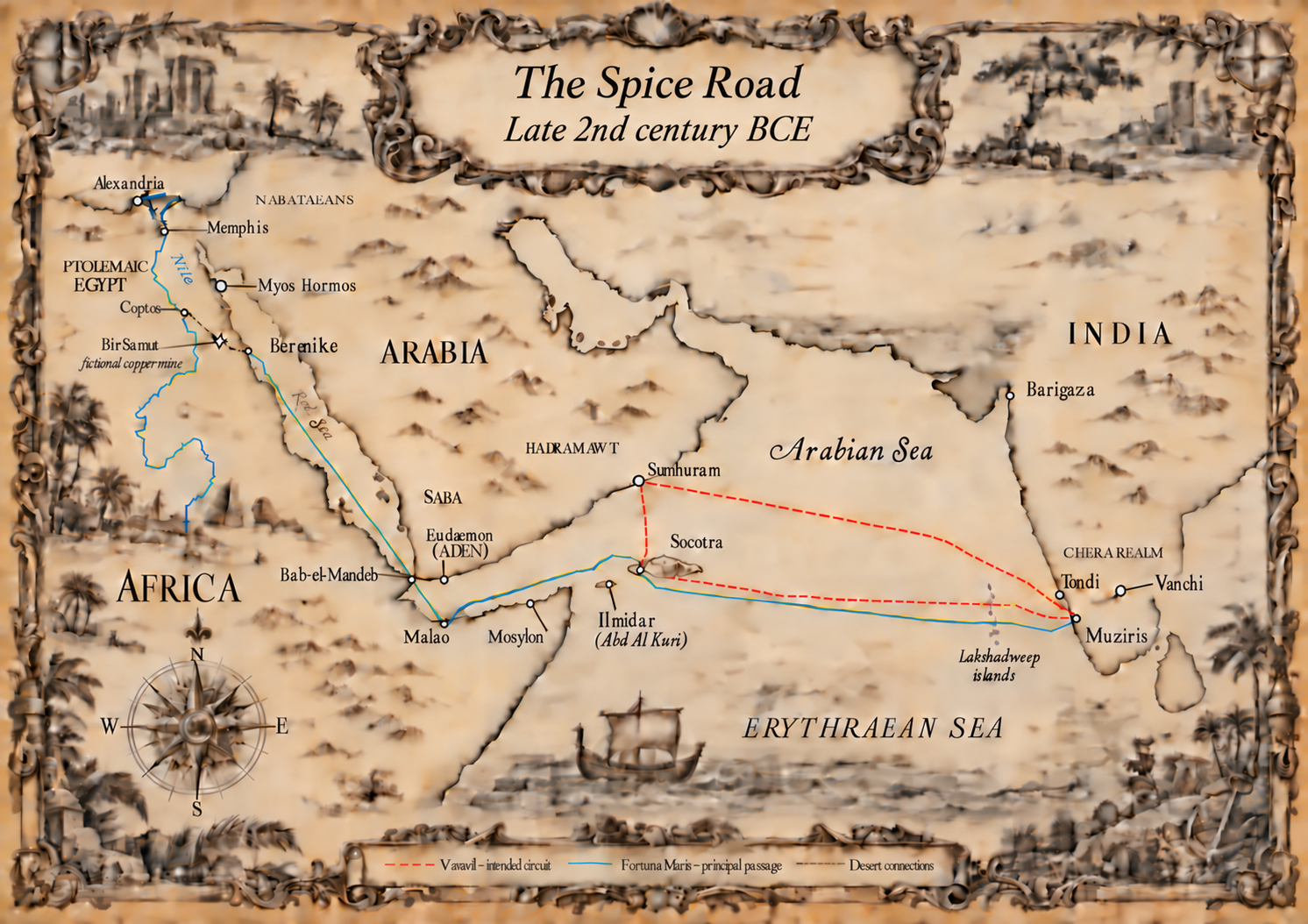
May you live long, my heart! I will not cause them to shed clear tears, her proud, moist eyes with red lines, that resemble two new blue waterlilies, opened by bees, tied together, from the large, deep springs of Murukan’s Thirupparankunram with endless festivities and victory flags with peacocks with many spots, west of Koodal city where flags sway, belonging to the victorious Pāndiyan king with many tall, fine elephants, who surrounded with uproar the wealthy Musiri town of Cheran, where, causing the huge, beautiful Periyāru river’s white foam to become muddied, the fine ships of the Yavanas come with gold and leave with pepper…
To those who are bound for India, Ocelis is the best place for embarkation. If the wind, called Hippalus, happens to be blowing, it is possible to arrive in forty days at the nearest mart of India, Muziris.
Muziris, an ancient port city on the Malabar Coast, survives in a handful of records: the Muziris Papyrus, which lists cargo carried by the Hermapollon; the writings of Pliny; and a few poems of the Sangam age (roughly 300 BCE to 300 CE). The city appears on the Tabula Peutingeriana beside a temple dedicated to Augustus, the first emperor of Rome.
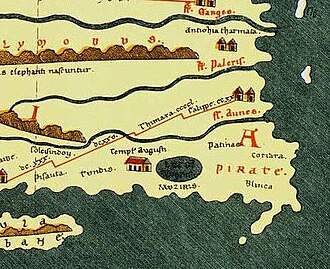
See Muziris on the Peutinger map · English viewer ↗
Muziris is mentioned in the Periplus of the Erythraean Sea. Written in Koine Greek by an anonymous sailor or merchant based in Egypt in the first century CE, the Periplus describes a port reached by ships from Arabia and the Greek-speaking world, where pepper was among the cargoes that drew merchants across the water.
The surviving record offers glimpses of the emporium of Muziris. Its precise site is still debated, though Pattanam is a leading candidate. The Sangam poems take us to a lush land and a city named Muchiris beside the Periyar River, but lavish their words on kings and chiefs.
For a novelist, the distance in time and space matters. A list of exports or a reference by Pliny cannot tell us how a dockworker greeted his brother, what a sailor feared, or how long someone waited for a ship that did not return.
In The Spice Road to Muziris, the port is a lived world. Trade reaches into households; loyalty and debt travel together; the sea promises opportunity while threatening to take away the people who make a place home.
To enter the fictional city is to look beyond the cargo. Behind every departure is a life left on the shore.
Discover The Spice Road to Muziris ↗