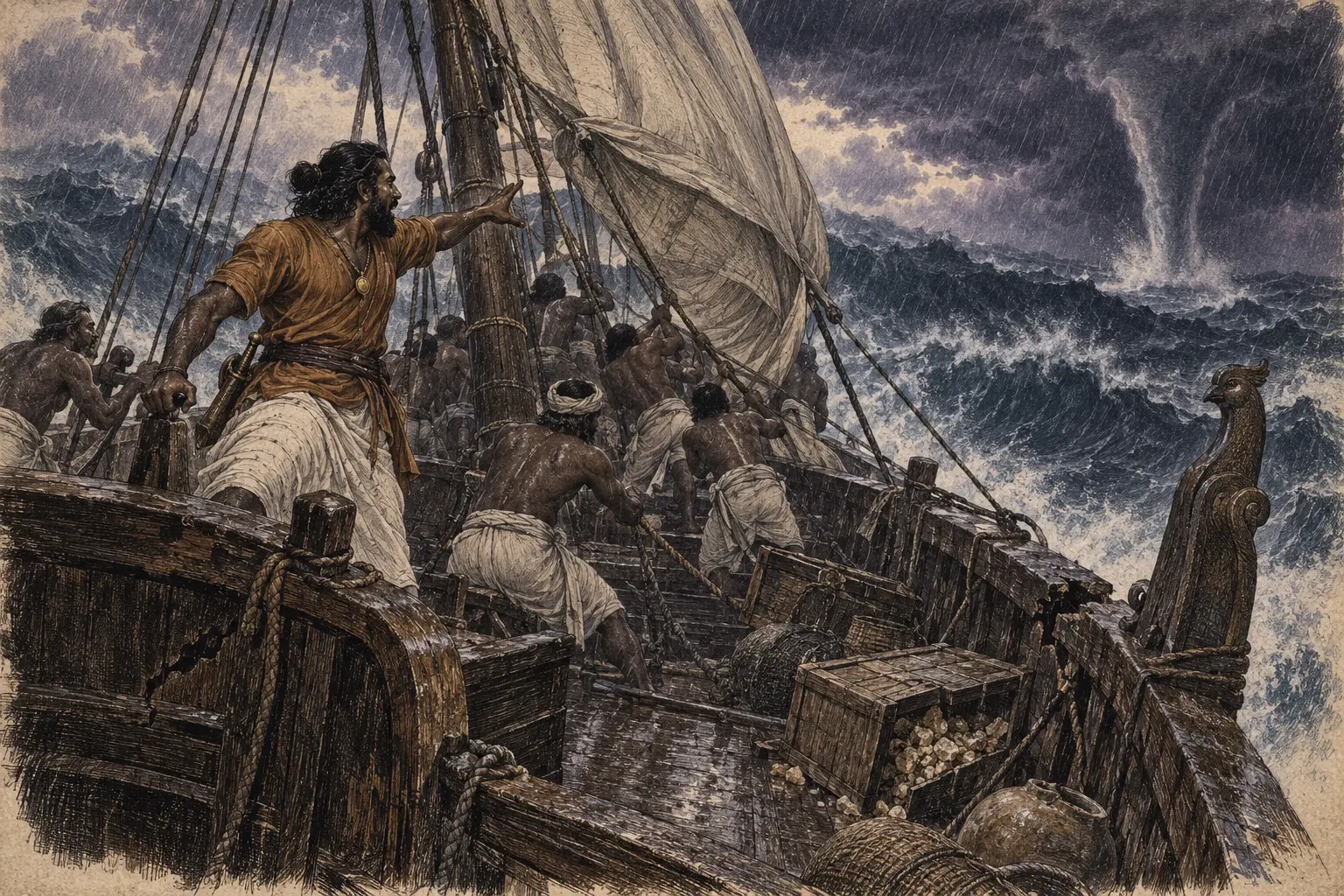
A road on land leaves a mark. A road across the sea has to be remembered.
The monsoon was the breath of the Indian Ocean that gave voyaging a seasonal rhythm. Winds that changed direction through the year made outward and return passages possible at different times. To sail was to understand the season and the stars as well as the sea.
The Spice Route that linked Ptolemaic Egypt and the Malabar Coast in the late second century BCE grew, under Rome, into a thoroughfare through which mountains of pepper and other spices and aromatics crossed the Indian Ocean on giant ships. They returned with so much gold that Pliny lamented in his Natural History:
The subject is one well worthy of our notice, seeing that in no year does India drain our empire of less than [fifty million] sesterces, giving back her own wares in exchange, which are sold among us at fully one hundred times their prime cost.
Elsewhere, in Book 12, he continues:
But it is the sea of Arabia that has even a still greater right to be called “happy,” for it is this that furnishes us with pearls. At the very lowest computation, India, the Seres, and the Arabian Peninsula, withdraw from our empire one hundred millions of sesterces every year—so dearly do we pay for our luxury and our women. How large a portion, too, I should like to know, of all these perfumes, really comes to the gods of heaven, and the deities of the shades below?
The Periplus of the Erythraean Sea, written long after the period of the novel, preserves some of that practical knowledge: ports, cargoes, sailing seasons and the open-water passage towards India. Behind its instructions lies a world of experienced sailors and decisions that could not be postponed indefinitely.
The Spice Road to Muziris imagines the origins of this ancient trade route connecting Ptolemaic Egypt to the Malabar Coast.
Discover The Spice Road to Muziris ↗